
An endangered species is a type of organism that is threatened by extinction. Species become endangered for two main reasons: loss of habitat and loss of genetic variation.
A loss of habitat can happen naturally. Dinosaurs, for instance, lost their habitat about 65 million years ago. The hot, dry climate of the Cretaceous period changed very quickly, most likely because of an asteroid striking the Earth. The impact of the asteroid forced debris into the atmosphere, reducing the amount of heat and light that reached Earth’s surface. The dinosaurs were unable to adapt to this new, cooler habitat. Dinosaurs became endangered, then extinct.
Genetic variation is the diversity found within a species. It’s why human beings may have blond, red, brown, or black hair. Genetic variation allows species to adapt to changes in the environment. Usually, the greater the population of a species, the greater its genetic variation.
Loss of genetic variation can occur naturally. Cheetahs are a threatened species native to Africa and Asia. These big cats have very little genetic variation. Biologists say that during the last ice age, cheetahs went through a long period of inbreeding. As a result, there are very few genetic differences between cheetahs. They cannot adapt to changes in the environment as quickly as other animals, and fewer cheetahs survive to maturity. Cheetahs are also much more difficult to breed in captivity than other big cats, such as lions.
The International Union for Conservation of Nature (IUCN) keeps a “Red List of Threatened Species.” The Red List defines the severity and specific causes of a species’ threat of extinction. The Red List has seven levels of conservation: least concern, near threatened, vulnerable, endangered, critically endangered, extinct in the wild, and extinct. Each category represents a different threat level.
Species that are not threatened by extinction are placed within the first two categories—least concern and near-threatened. Those that are most threatened are placed within the next three categories, known as the threatened categories—vulnerable, endangered, and critically endangered. Those species that are extinct in some form are placed within the last two categories—extinct in the wild and extinct.
⇝Scientific Name :- Loxodonta africana
⇝Conservation Status :- Vulnerable
⇝Population :- Aprroximately 415,000 in the wild
⇝Habitat :- Tropical and Subtropical Moist Broadleaf Forests, Flooded Grasslands and Savannahs, Miombo woodlands, Acacia savannahs
The African elephant is the largest animal walking the Earth. Their herds wander through 37 countries in Africa. They are easily recognized by their trunk that is used for communication and handling objects. And their large ears allow them to radiate excess heat. Upper incisor teeth develop into tusks in African elephants and grow throughout their lifetime. There are two subspecies of African elephants—the Savanna (or bush) elephant and the Forest elephant. Savanna elephants are larger than forest elephants, and their tusks curve outwards. In addition to being smaller, forest elephants are darker and their tusks are straighter and point downward. There are also differences in the size and shape of the skull and skeleton between the two subspecies.
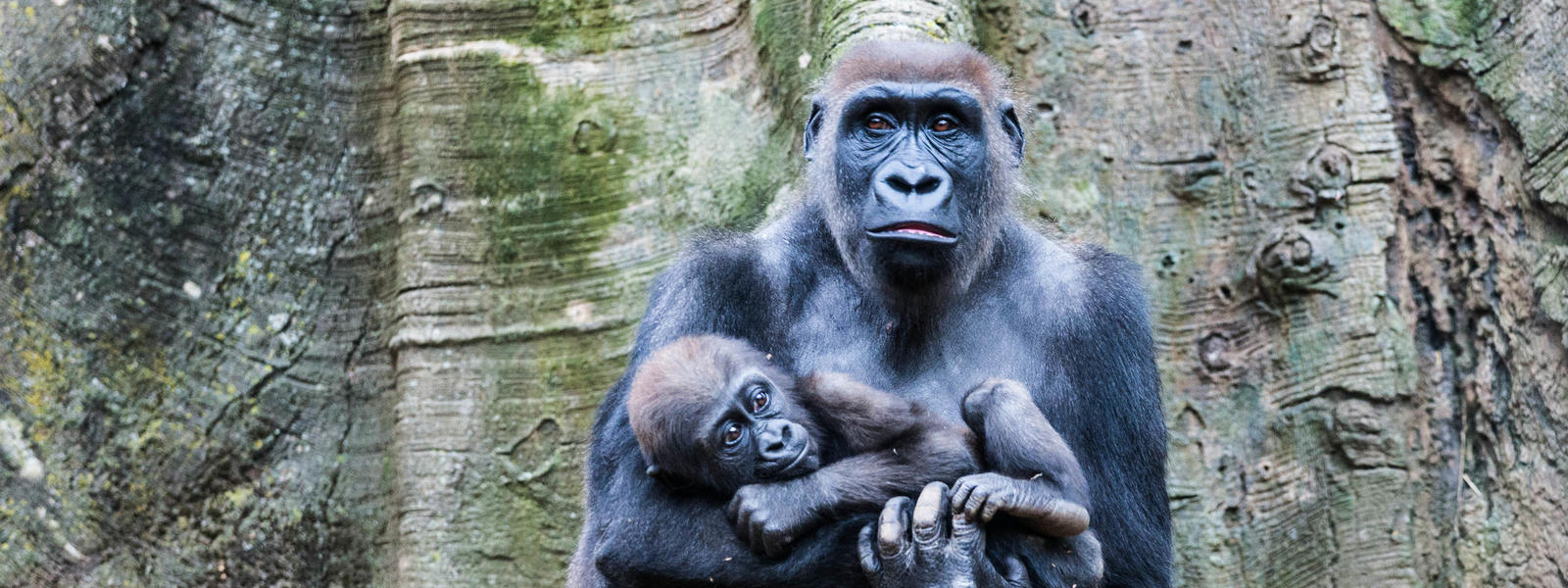
⇝Scientific Name :- Gorilla gorilla diehli
⇝Conservation status :- Critically Endangered
⇝Population :- 200 to 300 individuals
⇝Habitat :- Forests
This subspecies of the western gorilla is very similar in appearance to the more numerous western lowland gorilla, but subtle differences can be found in the skull and tooth dimensions. Cross River gorillas live in a region populated by many humans who have encroached upon the gorilla’s territory—clearing forests for timber and to create fields for agriculture and livestock. Poaching occurs in the forests as well, and the loss of even a few of these gorillas has a detrimental effect on such a small population.

⇝Scientific Name :- Eretmochelys imbricata
⇝Conservation status :- Critically Endangered (Population Decreasing)
⇝Population :- Approximately 20,000 nesting females
⇝Habitat :- Mesoamerican Reef, Coastal East Africa, Coral Triangle
Hawksbills are named for their narrow, pointed beak. They also have a distinctive pattern of overlapping scales on their shells that form a serrated-look on the edges. These colored and patterned shells make them highly-valuable and commonly sold as "tortoiseshell" in markets.

⇝Scientific Name :- Panthera uncia
⇝Conservation status :- Vulnerable
⇝Population :- total estimated 4,080-6,590
⇝Habitat :- Cold High Mountains
The snow leopard’s powerful build allows it to scale great steep slopes with ease. Its hind legs give the snow leopard the ability to leap six times the length of its body. A long tail provides balance and agility and also wraps around the resting snow leopard as protection from the cold.

⇝Scientific Name :- Thunnus albacares
⇝Conservation status :- Near threatened
⇝Habitat :- Oceans
Yellowfin tuna are torpedo-shaped with dark metallic blue backs, yellow sides, and a silver belly. They have very long anal and dorsal fins and finlets that are bright yellow. Yellowfin can live up to six or seven years. They are highly migratory and are found throughout the Pacific, Atlantic and Indian Oceans. They form schools with other tunas like skipjack and bigeye, and are also known to associate with dolphins. Yellowfin are able to breed year-round.